
Wasatch County Arrest Warrants Explained
An arrest warrant is a judge's order. In Wasatch County it issues after a probable-cause request to the court. Utah Rule of Criminal Procedure 6 governs the whole sequence: warrant versus summons, required information, entry and execution, service, return, review, and bail. A bench warrant is different. It follows a missed court date rather than a new charge. Start with the free Utah Statewide Warrants search. Then pull the case in Xchange, call the issuing court, and remember that the Wasatch County Sheriff may serve or transport under a warrant while only the court controls the order and its recall.
Wasatch County Rule Six Arrest Warrant Process
Rule 6 anchors every warrant in probable cause. A court cannot issue one without that showing. The warrant belongs to a case record, which may list the court, the case number, the charge, and bail information where available. Still, that detail does not settle current status. The official Utah Rule of Criminal Procedure 6 lays out the legal framework for Wasatch County cases. Whether a warrant remains active today is a question for the court.
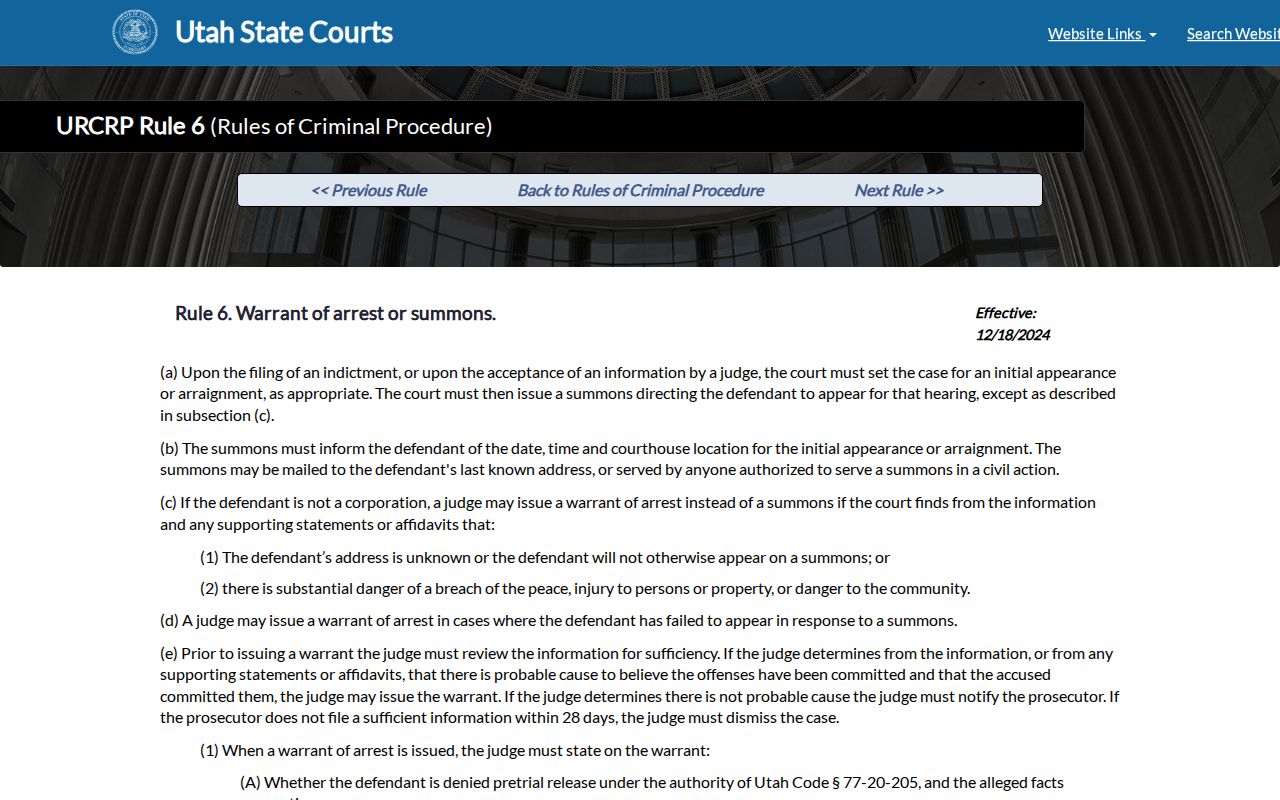
This source image is a rule reference, not a real person's arrest-warrant record.
Inside a Wasatch County Arrest Warrant
Read any warrant record next to its court case. Wasatch County publishes no public warrant-number format to check against. Take the case number from the official result and ask the clerk. The clerk can confirm any detail that seems unclear.
| Issuing court | Identifies the clerk who can speak to the order. |
|---|---|
| Case or warrant number | Links the warrant to court history; do not infer age or status from number format. |
| Charge | Describes the matter associated with the warrant. |
| Issue or recall event | Shows an administrative change that may need court confirmation. |
| Service event | May reflect that law enforcement acted, not that every court issue is over. |
| Bail field | Current terms depend on the court and case; no local schedule was found. |
Serving Arrest Warrants in Wasatch County
The Wasatch County Sheriff's Office lists warrant pursuit as a patrol function. Deputies may serve the paper. Corrections handles custody and transport. Heber City Police reports also show warrant service and cooperation with WCSO. Dated incident reports are not a warrant list. Call 435-654-1098 for general routing and 435-657-1619 for jail or custody questions. The FAQ gives GRAMA steps for case reports, and the office publishes no warrant-status line or surrender hours.
Comparing Arrest, Summons, and Bench Warrants
Utah Rule 6 covers both a warrant of arrest and the summons alternative. A bench warrant is different. It follows a missed appearance or a violated order, and in Wasatch County the name alone will not tell you which court to ask.
| Document | Common role | Wasatch County route |
|---|---|---|
| Arrest warrant | Authorizes an arrest after probable-cause review | Issuing court, then sheriff for service questions |
| Summons | Directs a person to appear in court | Issuing clerk and case notice |
| Bench warrant | May follow a missed date or court order | Court holding the missed-date case |
Wasatch County Arrest Records Have Release Limits
Warrant records in Wasatch County do not all open to the public at the same point. Arrest and search warrants differ. Utah GRAMA sets the classifications. Court rules can limit access, and juvenile matters follow a separate framework entirely. A law-enforcement system screen is not a court record. Ask the court clerk about access to a public court record, and for sheriff-held reports the WCSO FAQ routes requests through GRAMA.
Wasatch County Arrest Warrant Service Roles
Courts issue and recall judicial warrants in Wasatch County. Police or sheriff's deputies carry out the service. Corrections staff run the jail, and the jail number is the one for custody questions. These offices can share space at the 1361 South Highway 40 Justice Center campus, but they are not one desk.
Fourth District Court
District-court and felony case route for Wasatch County
435-654-4676
Ask the clerk about legal status. Ask the Wasatch County Sheriff for operational routing, and if an arrest seems imminent, let a lawyer advise on choices the public offices cannot decide for you.
Wasatch County Arrest Searches Can Miss Records
A warrant search in Wasatch County can miss. The statewide file depends on court reporting. Service updates arrive later. A record may fall under juvenile, sealed, or other restricted rules, or belong to a different court than expected. Search Xchange by case or citation number when available. Ask the issuing clerk to compare the state result with the court record. A blank result is not a court order saying no warrant exists.
If There's an Arrest Warrant for You
Do not act on a third-party result alone. Do not walk into a Wasatch County building on an uncertain match. Identify the issuing court through Xchange, call the clerk, and ask about status and the current process. A clerk explains procedure but cannot give legal advice, so a Utah attorney can review the case and discuss options.
Wasatch County publishes no local surrender hours, bond window, or payment method. Confirm instructions with counsel, the court, or the relevant sheriff or jail contact before travel.
Keep any written court confirmation or receipt. If the case also involves a missed court date, the Wasatch County bench warrant information covers the local review form.
Wasatch County Contacts May Differ by Page
Contact numbers for Wasatch County offices do not always match. The sheriff home page and FAQ give 435-654-1098. The county Criminal Division page prints 435-657-1098. Treat them as separate lines. Check the sheriff's current home page for the general contact, and use the issuing court for case status. The Fourth District contact page and the county court page describe different roles, and several offices share one county campus, so confirm which office you need before traveling.
Wasatch County Arrest Warrant Access
Wasatch County splits its records rules by statute. Utah Code 63G-2-301 sorts public records into classes, while Utah Code 63G-2-203 sets the clock for answering a request. Neither GRAMA section promises same-day access to every court file. Utah Code 80-6-202 keeps juvenile records apart entirely. So route your question to the right desk: the issuing clerk for court papers, or the WCSO records route for a sheriff report. The county warrant overview shows how Xchange, the clerks, and the sheriff connect.